




8 March – International Women’s Day
By Carolin Gluchowski, Gender and Inclusiveness Officer,
PCPSCE – Print Culture and Public Spheres in Central Europe (1500–1800)
International Women’s Day is often discussed in terms of visibility, voice, and participation—who gets to speak, who is listened to, and whose work is remembered. Print history adds an important twist to these questions: it reminds us that “the public sphere” was never a single stage with one spotlight. In early modern Europe, public life was made up of many overlapping publics—local and transregional, oral and written, formal and informal—shaped by the media through which people communicated, by social position and education, by language, and crucially, by gender. Recent scholarship has shown that these publics were segmented yet interconnected, with porous boundaries where different groups encountered each other in churches and marketplaces, in taverns and town halls, and through texts that travelled far beyond the places where they were produced. In other words, publicity was less a single arena than a shifting web of communication spaces—and print was one of the key technologies that helped to link them.
For the PCPSCE COST Action, which explores the entanglement of print culture and public spheres between 1500 and 1800, International Women’s Day is therefore not only a celebration, but also a prompt to ask a sharper historical question: what changed when print made communication more reproducible, portable, and durable? More specifically, how did print reshape the conditions under which women could take part in public communication—and what kinds of publics did their participation help to create?
Rethinking the “Public Sphere” in Early Modern Europe
Rather than a single arena of rational debate, early modern Europe was shaped by multiple, overlapping public spheres: local and transregional, oral and written, formal and informal, male-dominated and female-dominated. These spheres were not divided by fixed boundaries, but connected through porous thresholds across which texts, rumours, images, and people constantly moved. Public communication emerged wherever shared concerns were discussed—whether in a marketplace, a churchyard, a courtly ceremony, or a printed pamphlet—and its reach depended as much on media and mobility as on institutional access.
Gender played a defining role in how these communicative spaces were structured. Women and men often participated in different settings—village wells and spinning rooms, marketplaces and workshops, churches, taverns, courts, and salons—but these spaces were never fully isolated. They intersected through media. Print was one of the most powerful tools for connecting such partial publics, allowing ideas formed in local, gendered, or informal contexts to circulate more widely. By making communication more durable, repeatable, and mobile, print enabled words spoken in one place to be read, debated, and reinterpreted elsewhere, extending women’s participation beyond face-to-face interaction and embedding it within broader public conversations.
Pamphlets: Mobility, Controversy, and Occasion-Based Publics
Printed pamphlets offer a particularly vivid example of how print reshaped early modern publicity. Cheap to produce, easy to transport, and closely tied to current events, pamphlets flourished in moments of crisis—religious conflict, political unrest, moral scandal, or social anxiety. As historians of the early modern public sphere have shown, such moments gave rise to “occasional public spheres”: temporary but highly charged spaces of communication that emerged when shared values or accepted norms appeared under threat, prompting intensified debate and collective response
A well-studied example can be found in seventeenth-century England during the Civil Wars, when an unprecedented flood of pamphlets circulated in London and beyond. Women participated in this print explosion not only as readers and sellers, but also as authors and political commentators. Pamphlets attributed to figures such as Elizabeth Lilburne intervened directly in debates over imprisonment, justice, and political authority, translating personal experience into arguments of broader public relevance. Even when women’s authorship was anonymous or contested, their texts entered dynamic circuits of debate that linked household grievances to national political crises.
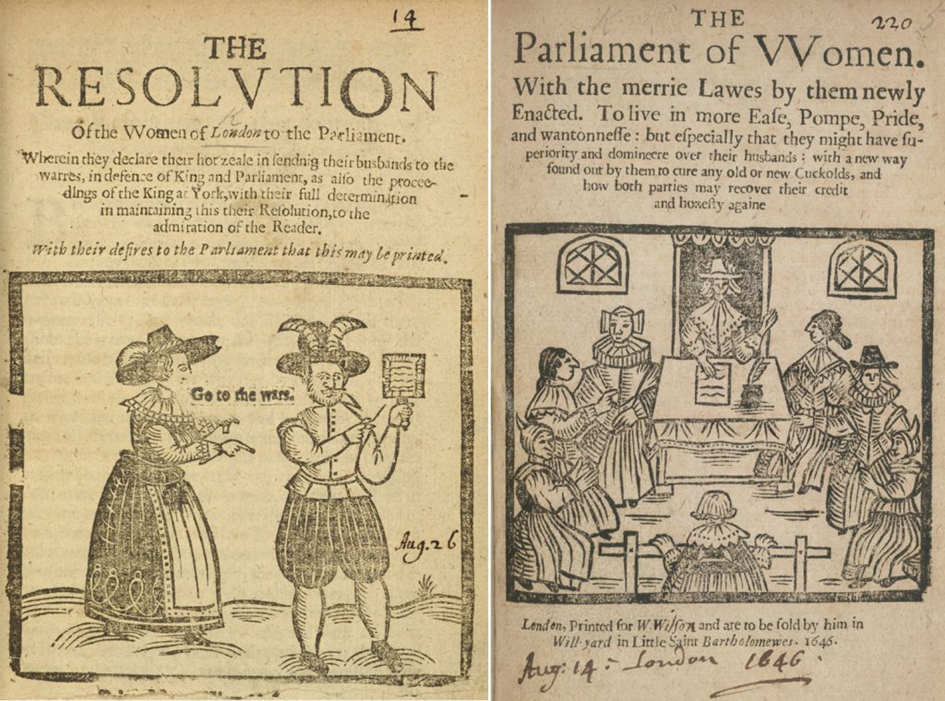
Figs. 1–2: ‘The Resolution of the Women of London to the Parliament’ (1642) and ‘The Parliament of Women (1646) © British Library.
More broadly, women participated in pamphlet-based publics in multiple roles: as authors, translators, commissioners, printers, sellers, and readers. Print thus enabled women’s voices—often framed through moral reasoning, religious reflection, or allegorical narrative—to circulate within political communication without requiring access to formal institutions of power. Pamphlets made it possible to speak politically without speaking as a politician, reminding us that early modern political communication was far more expansive and socially embedded than later, more restrictive models of political participation suggest.
Letters and Devotion: From Partial to Connected Publics
Print also transformed genres that were traditionally associated with privacy. Letters, once exchanged within relatively small circles of family, friends, or correspondents, could be copied, printed, and reframed for wider readerships. A well-known example is Madame de Sévigné (1626–1696), whose correspondence—originally addressed to her daughter—was copied, circulated, and eventually printed (BnF Les Essentiels), becoming a point of reference for social, moral, and political observation. Such letter collections show how personal writing could help connect and stabilise partial publics, especially where direct assembly or open debate was limited
A similar dynamic can be observed in devotional writing by women. Prayers, meditations, and spiritual counsel occupied an ambiguous position between inward reflection and outward instruction. When printed, these texts moved beyond the household and helped constitute moral and religious publics. Works such as those by Aemilia Lanyer (1569–1645) addressed readers collectively, shaping norms of belief, conduct, and communal responsibility. These examples remind us that public influence did not depend on overt political argument: shared reading and moral reflection could also generate powerful forms of publicity.
An Eastern European Perspective: Judith Rosanes and Print-Based Publics
To understand the geography of women’s participation in public communication, it is essential to look beyond Western Europe and to consider how transregional public spheres were sustained through long-term printing activity, multilingual practice, and the movement of texts across political and confessional boundaries. While there is ample evidence of Jewish women working in printing alongside fathers and husbands, Judith Rosanes (d. 1805) stands out as the first Jewish woman known to have operated as a commercial printer in her own right over an extended period of time, spanning more than twenty-five years. Active in what is now Ukraine, first in Żółkiew/Zhovkva and later in Lviv/Lemberg, Rosanes worked within established family-based printing networks while also asserting her own professional presence.
From a PCPS-CE perspective, Rosanes’s career exemplifies how transregional public spheres were built through print infrastructures rather than confined to singular locations or authorship models. By managing production and enabling the circulation of Hebrew religious and scholarly texts across cities, languages, and communities, Rosanes linked local publics to wider networks of readership. Her work demonstrates that women’s participation in public communication often operated through mediation, continuity, and material practice—showing how print made possible forms of public presence that extended beyond formal authorship or political speech, yet were central to the formation of early modern publics.
Why Print Matters for Women’s Public Participation
Seen through this lens, print did not simply “include” women in an already existing public sphere. Instead, it reconfigured the architecture of publicity itself. By linking local and transregional publics, by connecting oral, visual, and written forms of communication, and by stabilising discourse over time, print created new conditions for participation. Women entered these spaces in varied ways—often indirectly, sometimes controversially, but decisively—through writing, mediation, labour, and circulation.
On International Women’s Day, this perspective invites us to move beyond simple narratives of exclusion versus inclusion. It encourages us to recognise the multiple, gendered, and media-dependent publics in which women have long been active participants. Understanding these historical dynamics also sharpens our awareness of the present: today’s scholarly and digital infrastructures, much like early modern print, continue to shape whose voices circulate, whose labour is recognised, and how participation in public life is enabled—or constrained.
About the Author
On this International Women’s Day, I would also like to introduce myself as the new Gender and Inclusiveness Officer of the PCPSCE COST Action. I am Dr Carolin Gluchowski, a postdoctoral researcher in the European Early Modern History at the University of Hamburg, where I work on manuscript and print cultures, devotional practices, and historical communication structures. My research explores how devotional and communicative practices shaped cultural life in late medieval and early modern Europe, with a particular focus on women’s textual communities and material practices.
As Gender and Inclusiveness Officer, my mission is to help cultivate a collaborative and reflective environment in PCPSCE where diverse voices — across identity, geography, discipline, and career stage — can be heard, supported, and mobilised to shape the future of research on print, communication, and public spheres. I am especially committed to promoting equitable participation within our Action, including mentoring initiatives, fostering inclusive dialogue, and ensuring that structural barriers to engagement are identified and addressed.
Thank you for reading — and I look forward to engaging with many of you throughout the year.
Gender Equality & Inclusiveness Campaign
All blog posts marked with a pink/violet heading are part of the Gender Equality and Inclusiveness (GE&I) campaign of the PCPSCE COST Action. Through these contributions, we highlight research perspectives, historical actors, and scholarly practices that foreground questions of gender, participation, and inclusivity in the study of print culture and public spheres. This campaign is ongoing—more posts, voices, and themes will follow. Keep an eye out!
Scholarly references
Margaret J. M. Ezell, Social Authorship and the Advent of Print (Johns Hopkins University Press, 1999).
Paula McDowell, The Women of Grub Street: Press, Politics, and Gender in the London Literary Marketplace, 1678–1730 (Oxford University Press, 1998).
Wolfgang Schmale et al., “Public Sphere,” in Encyclopedia of Early Modern History Online (Brill, 2015).