




by David G. Rodenko
In Keeping the Past in Circulation, Carolin Gluchowski describes how connections across collections can be recovered by linked catalogue records.[1] In this context, Comenius’s Orbis sensualium pictus records give a sense of what such connections involve.
When we bring publication descriptions together under one title, including digital reproductions, they may still refer to completely different editions. If we treat every catalog record as a separate edition, we can artificially inflate the number of historical editions. Also, when we merge distinct publications, people associated with individual editions can appear to have been associated with the same publication. If we have two or more records with the same title and year of publication, they do not necessarily describe the same edition. Two library records therefore are not necessarily two different editions of a book.
The Göttingen copy of Orbis sensualium pictus names Leutschoviae, Samuel Brewer, and provides the date 1685 on the title page. It also lists languages: ‘LATINA, GERMANICA, HUNGARICA, & BOHEMICA’.[2] The same book, but the Newberry copy, the title page shows London as the place of publication, and names Charles Mearne as bookseller, and Charles Hoole as the English translator.[3]
Both catalogues provide 1685 as the publication date, and identify Comenius as the author, with the uniform title Orbis sensualium pictus.[4] Together with the translation statement, these descriptions enable grouping the text under one work, while leaving open whether both belong to the same typographical edition.
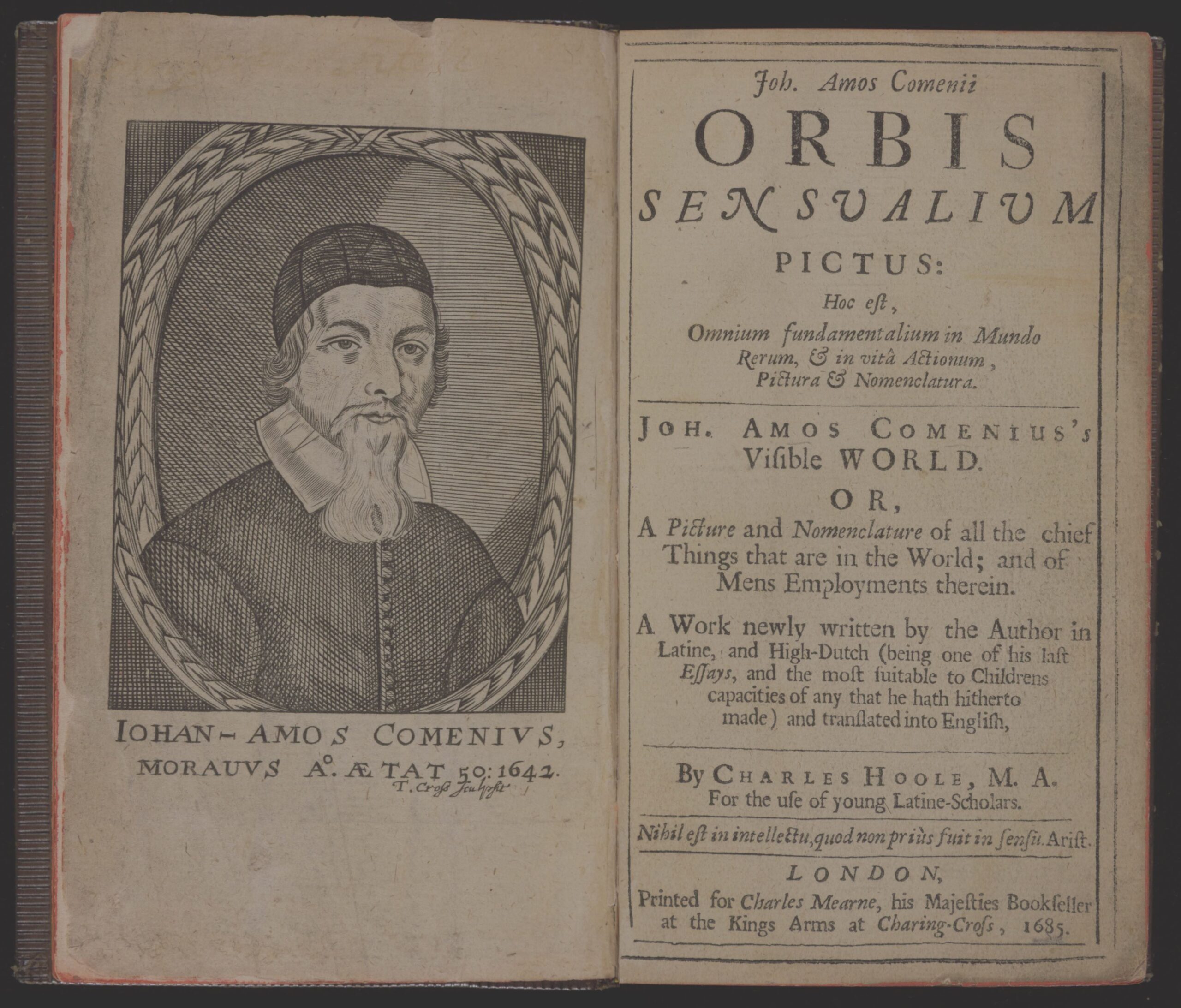
The English translation by Hoole is one language version, or expression, of Comenius’s work. It is the content of the work that determines its identity in the IFLA LRM model. Copies with the same content and intended physical characteristics under a common production plan form a manifestation. A multilingual publication, as a manifestation, can combine several such expressions. A single physical object is an item.[5] A catalogue record may contain information about several of these levels. However, identifying a manifestation does not determine how many typographical editions these records represent.
According to the DCRM(B) standard for early printing, an edition consists of all copies produced from the same typographical composition. Yet, a publisher can divide this edition into distinct publishing units, called issues, which are differentiated by features such as their imprints. Each issue can have its own catalogue record, so even if copies feature a different imprint, they can be described separately without immediately being treated as a new typographical edition. Hence, if we want to confirm whether they belong to the same edition, we need physical evidence from the typesetting. For this we can match line endings or catchwords, or sometimes appropriate bibliographical documentation.[6]
In this case, the ‘Deus’ passage on pages 6 and 7 provides this evidence. It takes up four language columns in the Leutschoviae copy and two in the London copy. The Latin text is also arranged differently across lines and pages. For example, the word ‘Sanctus’ appears on page 6 in the first copy, but can be found far on page 7 in the second one.[7] Together with the different language combinations and imprints, differences in typesetting support that the two copies belong to separate editions.
Interestingly, the Göttingen catalogue contains two separate records, one for the 1685 printed publication and another for its 2015 digital reproduction. Treating the place of digitisation as the place of printing would distort the publication’s historical map. The PPNanalog field links the digital record, PPN815802552, to the print record, PPN71627504X. The location and shelfmark identify the digitised copy as SUB Göttingen, 8 LING I, 3052.[8] Treating both records as historical editions would mean counting the same edition twice.
On the other hand, the Newberry Library provides two digital resources linked to a single catalogue record. The wing_zp_645 resource contains selected images, including the spread compared above, while wing_zp_645_m46_tp shows the title page to verify the imprint. In both cases, the metadata.description field points to the same record: alma993052488805867.[9] However, both resources have their own descriptions and identifiers. Consequently, as access points, they do not add any new historical editions.
The Newberry catalogue lists Mearne as a ‘printer’, while the title page names him a bookseller.[10] Both details, alongside their sources, should be kept. In our network, based on the imprint, we link Mearne to the London publication as a bookseller. We link Brewer to the Leutschoviae publication as a printer, and Hoole to the London one as a translator, and labels explain why each person is in the network.
If we merged the publication nodes, we would incorrectly link Brewer, Mearne, and Hoole to the same edition. In the given network, this would suggest a single shared publication despite evidence clearly pointing to two separate ones. Grouping these individuals together seems only justified in a network centered around studying their involvement in its various editions and translations. Keeping a shared node for the work alongside separate nodes for the publications enables a precise analysis of both issues. For analyses of editions and their associated agents, linked datasets should maintain the distinction between works, editions, physical copies, and catalogue records.
Table 1. Relationships and decisions
| Records | Evidence | Relationship and count |
| Göttingen Print PPN71627504X Digital PPN815802552 Copy 8 LING I, 3052 VD17 7:719991E | METS, PPNanalog and shelfLocator. Print record identifies the digitised copy. | Recorded reproduction link. One historical edition. |
| Newberry wing_zp_645 wing_zp_645_m46_tp alma993052488805867 | Image metadata and title page metadata, metadata.description. | Recorded links to one catalogue record. No additional historical edition. |
| 1685 publications PPN71627504X alma993052488805867 | Shared author and title. Different Latin typesetting. Göttingen p. 6 and p. 7. Newberry pp. 6 and 7. | Proposed work grouping. Two distinct editions. |
[1] Carolin Gluchowski, Keeping the Past in Circulation, PCPSce, 15 September 2026.
[2] Comenius, Orbis sensualium pictus quadrilinguis (Leutschoviae, 1685), title page. SUB Göttingen, 8 LING I, 3052.
[3] Comenius, Orbis sensualium pictus (London, 1685), title page. Newberry Library.
[4] SUB Göttingen, PPN71627504X. Newberry Library, alma993052488805867, MARC fields 100, 240 and 260.
[5] Pat Riva, Patrick Le Bœuf and Maja Žumer, IFLA Library Reference Model (2024), pp. 21 to 28 and 93.
[6] RBMS and Library of Congress, Descriptive Cataloging of Rare Materials (Books), third printing (2011), p. 200 and Appendix E, pp. 175 to 177.
[7] Comenius, Orbis sensualium pictus (1685). Leutschoviae, p. 6 and p. 7. London, pp. 6 and 7.
[8] SUB Göttingen, METS for PPN815802552, PPNanalog, shelfLocator and originInfo. Print record PPN71627504X.
[9] Newberry Library, metadata for wing_zp_645 and wing_zp_645_m46_tp, metadata.description.
[10] Newberry Library, alma993052488805867, MARC 700 $e. Compare the London title page.