




By Anna-Marie Pípalová, Postdoctoral Researcher, Charles University; PCPSCE Science Communication Officer
PCPSCE – Print Culture and Public Spheres in Central Europe (1500-1800)
In honour of Women’s History Month and International Women’s Day, celebrated in March, the PCPSCE COST Action blog has highlighted the role of women in early modern print culture and public spheres. In today’s blog post, we turn to focus on women as the subjects of early modern printed works and on the depiction of gendered violence in early modern print.
The Thirty Years’ War, which has been described as one of the most violent European conflicts before the twentieth century, profoundly impacted the lives of Central European populations for much of the seventeenth century and exposed populations to frequent experiences of violence, atrocity, and plunder. The gendered experiences of wartime violence were captured in print, including in Hans Jakob Christoffel von Grimmelshausen’s novel Der abenteuerliche Simplicissimus (1668, revised and expanded in 1669), which provided a vivid literary testament to the horrors of the Thirty Years’ War.
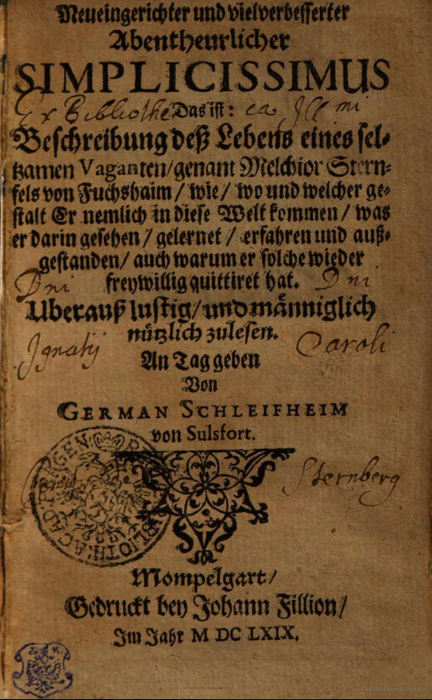
Image source: NK ČR 22 L 000006, no copyright – non-commercial use
Grimmelshausen’s novel described the plunder, murder, and sexualised violence which was a feature of the ‘small war’ which accompanied the conflict. When the narrator’s village is plundered in the novel, he described how “Our maiden was so maltreated in the stable, that she could no longer go out of there” (pg. 17).
In the novel, the narrator also hinted at the sexualised violence which the women experienced during the plunder: “Of the captured women, maids, and daughters, I can say nothing in particular, because the soldiers did not allow me to see how they dealt with them: this alone I know well, that one heard dreadful screams here and there from the corners, and I can well assume that my mother and our Ursula were not treated better than the others.” (pg. 18)
Such descriptions of gendered and sexualised violence abound in Grimmelshausen’s narrative. Printed seventeenth-century histories of the war did not always discuss the violence which women experienced during the war as openly as Grimmelshausen’s novel, but gendered experiences of violence were a prominent feature of the war. Bohemian seventeenth-century accounts of Thirty Years’ War iconoclasm, which was a prominent feature of plunder and small war, provide us with evidence of the gendered experiences of symbolic violence aimed at Marian images. Symbolic iconoclastic violence aimed at religious images was prominently commemorated in Bohemian print culture, art, and ecclesiastical space.
Jan Ignác Dlouhoveský’s account of Our Lady of Boleslav described the capture and hanging of Our Lady of Boleslav by the soldiers of Lorenz von Hofkirchen. Hanged from the gallows at Old Town Square in Prague in 1632, Dlouhoveský described the statue as hanging in isolation amid a crowd of soldiers, until the Bohemian noble woman Alžběta z Plavna ran into the centre of the crowd and begged the Virgin Mary to revenge herself upon the soldiers. Another Bohemian noble woman, Kateřina Benigna z Lobkovic, was described by Bohuslav Balbín as playing a key role in the return of Our Lady of Boleslav to Bohemia from Leipzig. In seventeenth-century Bohemian accounts, women and women’s piety were thus represented as key agents in responses to looting and iconoclasm during the Thirty Years’ War.
Works discussed:
German Schleifheim von Sulsfort [Hans Jakob Christoffel von Grimmelshausen], Neueingerichter und vielverbesserter Abentheurlicher Simplicissimus Das ist: Beschreibung deß Lebens eines seltzamen Vaganten/ genant Melchior Sternfels von Fuchtshaim/ wie/ wo und welcher gestalt Er nemlich in diese Welt kommen/ was er darin gesehen/ gelernet/ erfahren und außgestanden/ auch warum er solche wieder freywillig quittiret hat (Mompelgart: Gedruckt bey Johann Fillion, 1669).
Jan Ignác Dlouhoveský, Djl Druhý/ Zdoro=Slawiček na Poli Požehnaném/ Totiž: Dokonalegssj/ přjgemněgssj/ Swětlegssý a bljžssý Spráwa o Swato=Swatém a Zázračném Obraze Panny Marye Staro=Boleslawské ([Praha]: Wytisstěnný w Ympressy Arcý=Bisk. [s.d.]).
Bohuslav Balbín, Epitomes Rerum Bohemicarum, seu: Historiae Boleslaviensis Libri Duo: VI. & VII. Quorum Prior, Gloriam Antiquissimae Collegialis Ecclesiae Vetero-Boleslaviensis; Alter, Origines et Gratias Coelestes Gloriosae Dei Matris Mariae, Quae Ibidem Vetero-Boleslaviae Ab Annis Propemodum DCCC. Colitur, Comprehendit (Prague: 1673), “Diva Boleslaviensis”.
Further reading:
Mara R. Wade. ‘Reading Rape: Gendered Discourses of Sexual Violence. Grimmelshausen and the Sack of Magdeburg’, in Ethik – Geschlecht – Medizin. Körpergeschichten in politischer Reflexion, ed. Waltraud Ernst. Internationale Frauen- und Genderforschung in Niedersachsen, Focus Gender 14 (2010): 17-39.