



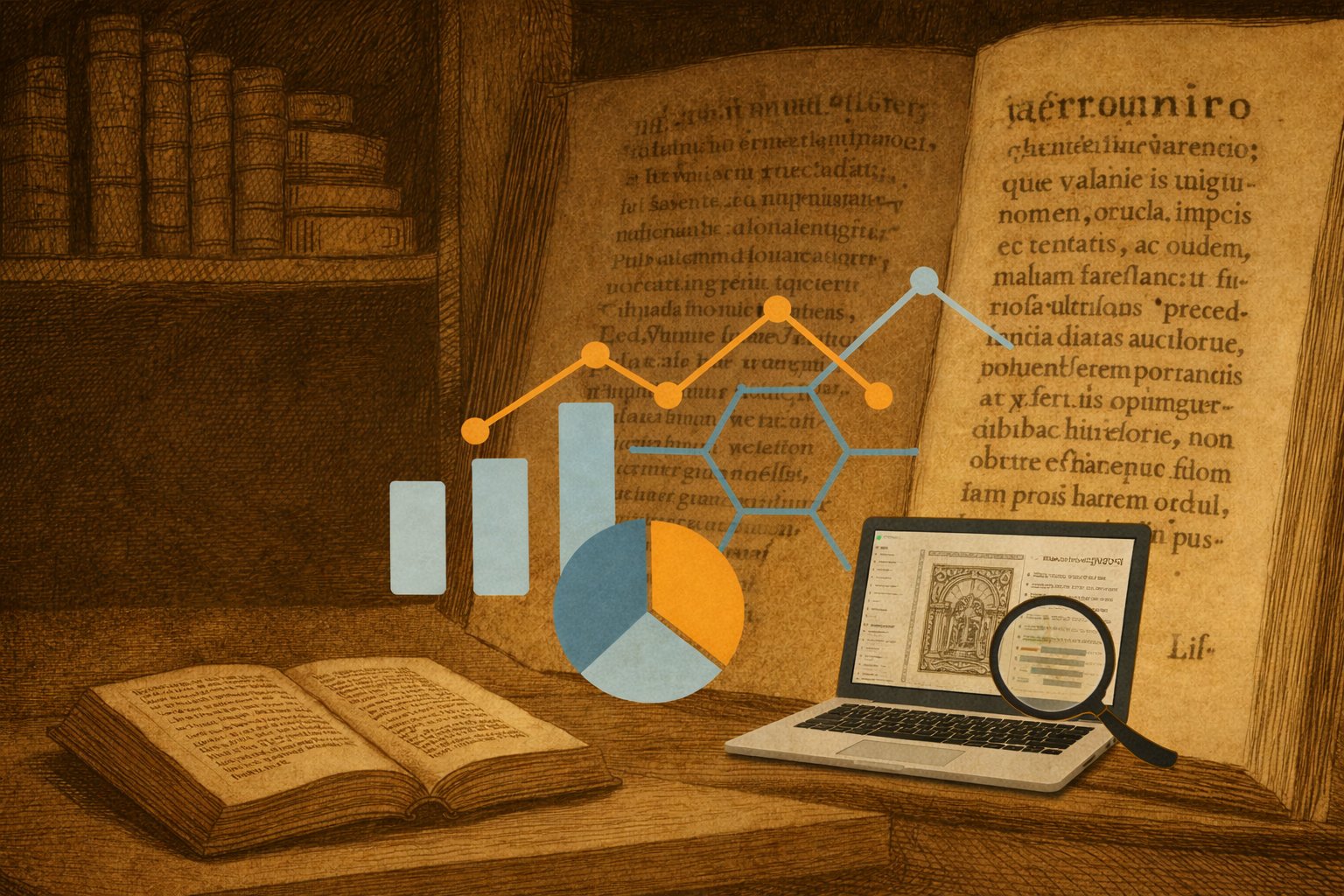
PCPSCE‘s Working Group 2, dedicated to tools and data, organised its first Hackathon at the University of Vienna. Conceived as an intensive yet deliberately unstructured forum, the three-day event invited Action members to collaborate in small groups on datasets they brought with them, free from a rigid timetable. This format encouraged experimentation, peer learning, and the cross-pollination of methods across disciplines.
The primary emphasis lay on bibliographical data—ranging from retrospective national bibliographies to library catalogues—but participants also worked with a diverse array of materials. These included textual corpora, such as legal documents related to censorship and emblematic poetry, as well as visual sources like woodcuts, which were explored using computer vision techniques. All results and workflows have been documented in a shared GitLab repository with restricted access, ensuring both transparency and continuity for future work.
The hackathon was framed by a wide-ranging introductory lecture from Péter Király (whose lecture is available on the CA-YouTube channel “DH-Lectures” and slides on Zenodo), together with a comment by computational communication scientist Jana Bernhard-Harrer. Together, these contributions sketched a conceptual foundation for data-driven investigations into the relationship between print culture and public spheres, situating the hands-on work within a broader theoretical horizon.
Next, it will be up to the individual researchers to decide which projects they wish to pursue further – ideally in close alignment with the topical requirements of the Compendium, to be discussed at the Conceptual Reatreat in February -, and up to the leadership of WG2 to determine which will form the central arguments for the second hackathon, scheduled for roughly one year from now. A call will be issued in late spring 2026.
If you are interested or have any questions, please contact Thomas Wallnig and Joëlle Weis.