



“Print Culture and Translation in Central Europe (1500–1700): Methods, Problems and Approaches”
written by Kristi Viiding
Day 1 – Arrival, Keynote Training & Historiography Panel
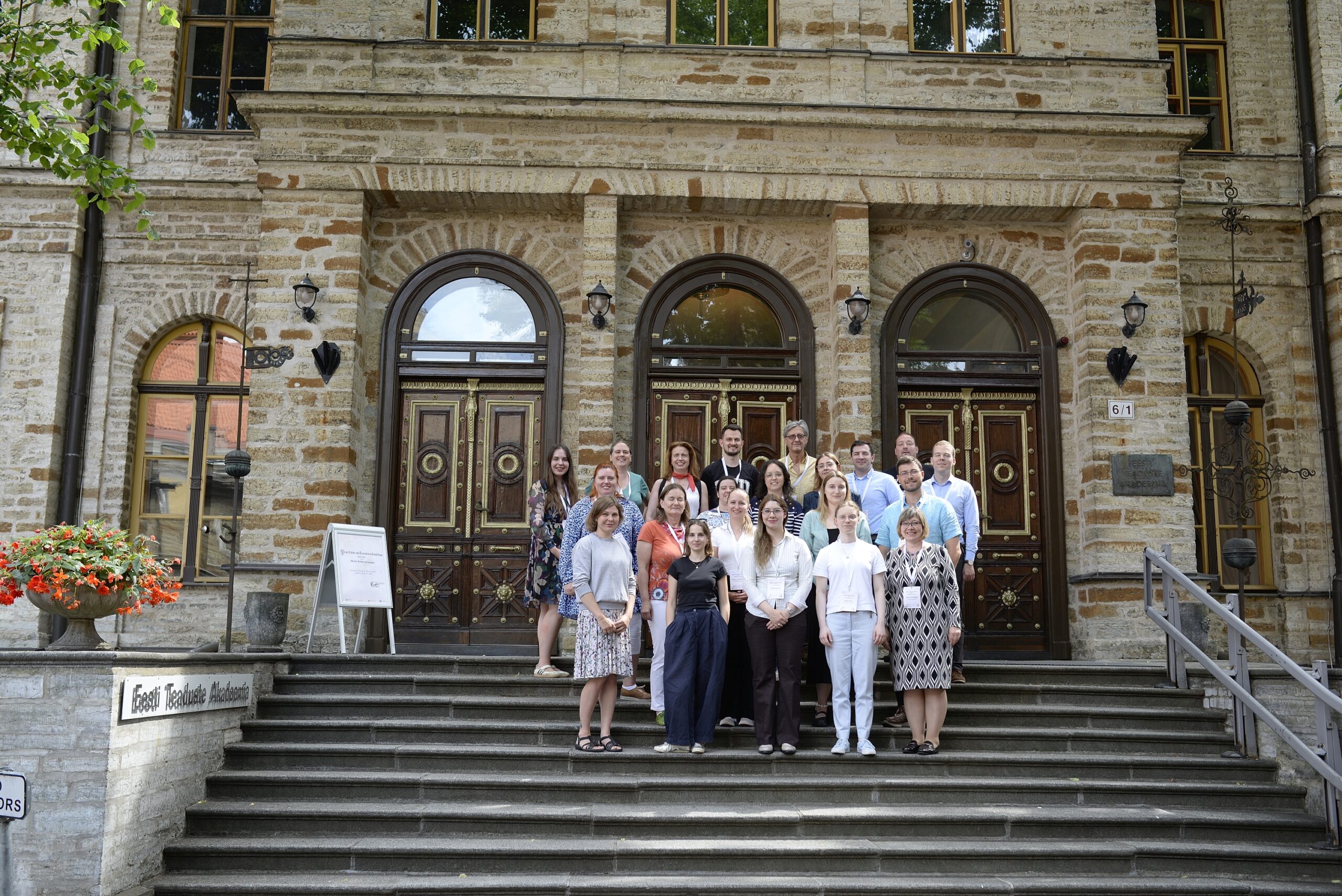
The COST Action CA23137 (PCPSCE) YRI Summer School 2026 officially commenced on Tuesday, 30 June, at the Under and Tuglas Literary Institute of the Estonian Academy of Sciences in Tallinn. The event opened with welcoming addresses from Kristi Viiding (Director of UTL Tallinn) and Ivan Almes (Department of History, Ukrainian Catholic University / WG5 Co-leader), who welcomed participants and set the framework for the week’s focus on print culture and translation across Central Europe. The summer school took place in the main building of the Estonian Academy of Sciences, the beautiful Ungern-Sternberg Palace on Toompea, built between 1865 and 1868.
The first training session was delivered by László Kontler (Central European University), titled “Translation and Reception in Early Modern European Intellectual History”. His lecture provided a comprehensive theoretical overview of interlingual translation as a vehicle for the transmission of ideas between c. 1500–1800, detailing the motivations, intentions, and structural transformations of the early modern translation industry in response to evolving readerships and book markets.
In the late afternoon, the first participants’ panel, “Historiography and Communication” (moderated by Ivan Almes), featured four poster presentations: Juliana Hudecová (Masaryk University, Brno) examined the stylistic differences between the Czech and German editions (1499 and 1500) of Welmi piekna nowa Kronika 1519. Anna-Marie Pípalová (Charles University, Prague) explored the multilingual interplay of Czech, German, and Latin in 17th-century Bohemian historiography. Mark Alexander Ummelas (University of Tallinn) discussed the early modern German-speaking cultural perception and image of Russians. Anders Dyrborg Birkemose (Aalborg University) presented on the newspaper medium Intelligence papers within Danish media historiography.
The day concluded with a dinner in the Museum Garden of the Under and Tuglas Literary Institute, in the green suburb of Tallinn.
Day 2 – Methodological Approaches, Early Modern Printing & Digital Humanities
Wednesday, 1 July, began with Training Session 2 led by Veronika Čapská (Charles University / Czech Academy of Sciences), who presented useful concepts and approaches in translation history. She explored theoretical frameworks such as Lawrence Venuti’s “turn to translators,” Manuel Castells’s “translation flows,” Massimo Rospocher’s public sphere concepts, and the material and typographic mediation of translated texts. This was followed by Participants Panel 2, “Prints, Ideas, Genres” (moderated by Kristi Viiding), featuring five poster presentation by the young researchers. Helena Žáčková (Library of the Czech Academy of Sciences, Prague) surveyed Bohemian printing production from the 16th to 18th centuries by women printers. Anisia Iacob (University of Kent and King’s College, London) traced the circulation of Anti-Trinitarian ideas and Servetianism in 16th–17th-century Central-Eastern Europe. Orsola Lorena Purcaro (University of Innsbruck) analyzed early modern bilingual editions of Aesop’s Fables as tools for language learning and moral instruction. Michał Heintze (Adam Mickiewicz University, Poznań) addressed publishing and editorial issues in Lyricorum libri by Maciej Kazimierz Sarbiewski SJ, and Madli Vanamölder (University of Tartu) presented on printed jubilee reports and the circulation of ceremonial academic rituals in early modern Europe.
In the afternoon, Training Session 3 was delivered by Marta Vaculinová (Institute of Philosophy of the Czech Academy of Sciences) on the problems of translation in 16th- and 17th-century Bohemian literature, highlighting language pairs, genre selections, religious and political influences, translator agency, and dedication networks.
The final lecture of the day, Training Session 4, was presented by Peeter Tinits (Max Planck Institute for Evolutionary Anthropology / University of Tartu). He introduced digital humanities methods for book history, demonstrating processing steps to harmonize bibliographic data and discussing the opportunities of large-scale data analysis.
The evening offered participants a guided tour of the Banned Books Museum, followed by a dinner at the historic Olde Hansa restaurant.
Day 3 – Digital Pipelines, Corpus Analysis & Cultural Heritage
Thursday, 2 July, opened with Training Session 5, delivered by Annemieke Romein (University of Twente). Titled “From Page to Parallel Text: A Beginner’s Pipeline for the Digital Study of Early Modern Translation,” the workshop introduced a step-by-step pipeline from optical character recognition in Transkribus to machine-readable parallel texts for translation analysis.
The morning continued with Participants Panel 3, “Digital and Visual” (moderated by Kaarel Vanamölder) with three poster presentations by four young researchers. Ada Migliazza and Antonia Foggia (University of Innsbruck) presented a digital platform for Neo-Latin studies, discussing its research opportunities and challenges. Killu Raja (Under and Tuglas Literary Institute) examined publications and references surrounding “The Hieroglyphics of Horapollo”between 1500–1700. Małgorzata Wojtkowiak (Adam Mickiewicz University, Poznań) analyzed visual iconography from Medici power imagery to Hermetic translations and their echoes in Central Europe.
Following a break, the last Training Session 6 was conducted by Anastasia Tenchurina (Charles University, Prague) on “Using AntConc for Historical Research.” Participants gained practical experience with corpus preparation, concordance indexing, keyword analysis, and computational textual pattern recognition tailored for humanities sources.
In the afternoon, participants visited the St. Nicholas Church and its famous Dance Macabre painting by Bernt Notke and took part in a guided tour in the Old Town. Our guide from the Tallinn City Museum showed objects related to the multicultural history of Tallinn and multi-interpretability of legends. The day concluded in a friendly atmosphere at the beer restaurant Humalakoda.
Day 4 –Archival Excursion & Final Discussions
The last day, Friday, 3 July, began with the final discussions led by YRI Coordinator Veronika Čapská. She expressed the group’s gratitude to the organizers. The session provided a forum for participant feedback, and reflection on the key methodological takeaways across the four days.
After the distribution of certificates, participants attended an archival excursion to the Tallinn City Archive, guided by Estonian historian Dr. Juhan Kreem, where they explored historical documents and local archival heritage. The Summer School provided a stimulating atmosphere for scholarly exchanges, and networking within the COST Action CA23137 framework.