




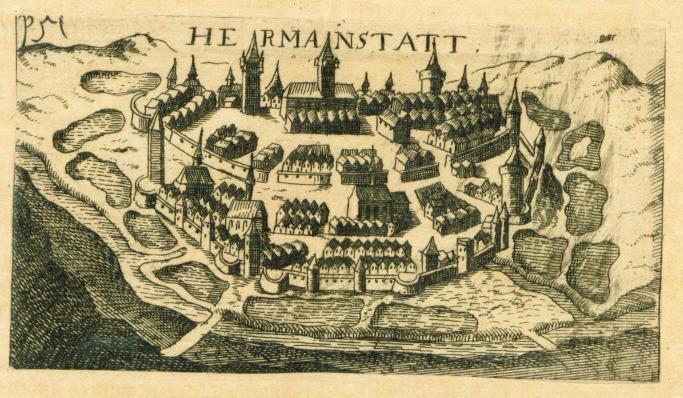
National Brukenthal Museum, Sibiu (Hermannstadt), Romania | 2-3 June 2027
What makes a culture small?
The concept of small cultures, associated particularly with Adrian Holliday, shifts attention from culture as a bounded entity (national, ethnic, or linguistic) to the practices and meanings produced within particular social settings.[1] Anthropological approaches to literacy similarly understand reading and writing as socially situated practices, embedded in particular relationships, institutions, and forms of know-ledge.[2]
The goal of the COST Action PCPSCE is to organize a conference that brings these perspectives together to explore small cultures, literacies, and print in Central Europe from c. 1400 to 1800.
We use small cultures not primarily to denote minority or subordinate layers, nor to imply fixed demographic or territorial limits. Rather, the concept invites us to examine the scale at which cultural practices were produced, shared, and reproduced, ultimately generating localized identity formation, cohesion, and attachment. Small cultural formations might develop around a locality, language, religious community, profession, school, literary circle, or network of readers and writers, while remaining connected to wider cultural and textual networks.[3]
This perspective raises questions about the relationship between literacy and print. How did reading, writing, copying, translating, teaching, and textual performance operate within small-scale cultural formations? How did manuscript and print interact? Did print extend, transform, or challenge the scale and boundaries of such cultures? And how did texts and knowledge move between small cultural formations and wider networks? How did literacy-related manifestations contribute to the emergence of localized identities and solidarities (or even to forms of autonomies)? What are the appropriate methods and scholarly doctrines for approaching the literate behaviour in small-scale cultures? What is the role played by agency and localized decision-making within set structural boundaries of larger cultural frameworks?
Central Europe’s multilingual, multiconfessional, and politically fragmented landscape offers a particularly productive setting for these questions. We welcome comparative, multilingual, transregional, and interdisciplinary contributions examining local, regional, linguistic, confessional, professional, or intellectual formations and their connections to wider networks of textual production and circulation.
Possible themes include:
- small cultures and vernacular or multilingual literacies;
- manuscript, print, and mixed media practices;
- reading, writing, translation, and textual mediation;
- small literary and linguistic cultures;
- religious, educational, professional, and intellectual communities;
- printers, scribes, translators, teachers, booksellers, and other mediators;
- circulation of texts and knowledge across linguistic and political boundaries;
- the impact of print on the scale and cohesion of small cultures;
- methodological approaches to reconstructing small cultures and their literacies.
The conference asks, ultimately: how did literacy and print enable small cultures to produce, maintain, and extend collective forms of knowledge, literate practice, and identity?
Please note that the potential publication of (a selection) the conference proceedings with an international academic publisher is currently being considered. Further details will be communicated at a later date.
[1] Adrian Holliday, ‘Small Cultures’, Applied Linguistics 20, no. 2 (1999): 237–264
[2] Brian V. Street, Literacy in Theory and Practice (Cambridge: Cambridge University Press, 1984)
[3] David Barton and Mary Hamilton, Local Literacies: Reading and Writing in One Community (London: Routledge, 1998)
How to apply?
We invite proposals for 20-minute papers. Please submit a title, 300–500-word abstract, short biographical note (up to 100 words), institutional affiliation, and 3–5 keywords.
We particularly welcome papers from researchers adopting comparative and interdisciplinary approaches, as well as those from young researchers and innovators (YRIs), as defined by the COST Association (under the age of 40).
The transportation and hosting costs of the COST Action members will be covered.
Non-COST Action members are strongly encouraged to apply; however, they must cover their own participation costs unless they become members of the COST Action.
Deadline for applications: 15 January 2027
Decision: 15 February 2027
Submissions to be sent at: smallcultures2027@mailfence.com
Organising committee
- Adinel-Ciprian Dincă
- Stefaniia Demchuk
- Nina Lamal
Header Image: https://commons.wikimedia.org/wiki/File:Hermanstatt_(Sibiu),_17th_century_engraving.jpg?uselang=de